


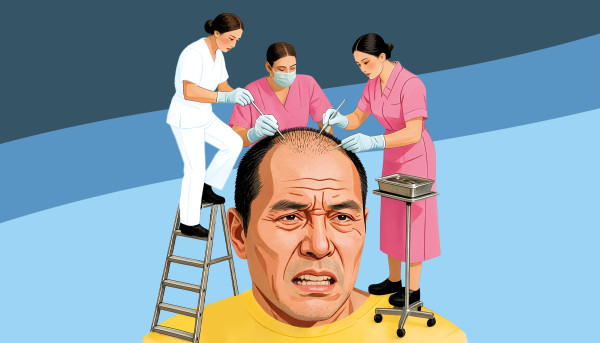
The desire to look attractive is universal. Both men and women hope to maintain a youthful appearance with fuller hair. As a result, the hair growth market has grown rapidly in recent years, with advertisements for hair transplant, hair growth and scalp care services commonly seen across the city. However, the Consumer Council receives around 100 complaint cases each year relating to services such as hair transplant, hair growth, hair and scalp care, involving issues such as doubts about exaggerated effectiveness claims, scalp inflammation, and detachment of artificial hair strands, often with significant sums of money at stake. Generally speaking, hair transplant and procedures involving injections are medical procedures. Traders should comply with Hong Kong legislation and arrange for locally registered medical practitioners to perform all medical procedures. Consumers should also proactively enquire whether the treatment involves such procedures and whether the service provider possesses the requisite professional qualifications.
The Council reminds the industry not to make promises that could not be fulfilled when promoting treatments. Traders should clearly explain the time expected to see results and the factors affecting treatment effectiveness, enabling consumers to make well‑informed choices. After treatments, traders should properly follow up on consumers’ conditions, show concern for their recovery progress and arrange follow‑up treatments as needed. The Council also reminds consumers that hair growth treatments are unlikely to yield immediate results, and various treatments might require long‑term follow‑up. Therefore, consumers should assess their own financial and time costs when considering whether to purchase such treatments, manage their expectations and avoid readily believing promotional materials featuring “real cases of customer scalp conditions” or celebrity endorsements, or relying on staff’s verbal promises. Consumers should also note that offers such as “free trial treatments” might be promotional tactics. They should consider carefully before accepting such offers to avoid suffering loss over small gains.
Case 1: Hair Growth Treatment Claimed “Visible Effect After 1 Session”
No Effect Observed and Refund Refused Citing Disclaimer Clause
The complainant saw a social media advertisement by Company A promoting a free trial of its hair growth treatment for new customers, together with free consultation and scalp analysis. He therefore visited Company A to enjoy the offer. After the free trial, Company A’s consultant recommended the RGA hair growth treatment[1], stating that no doctor consultation was required prior to the treatment, and also promoted laser treatment for stimulating hair growth. Although the complainant initially hesitated due to the high cost, the consultant claimed that laser treatment could be offered as a free gift and shared various successful examples of customers who allegedly achieved significant improvement after receiving the RGA treatment. Upon seeing promotional materials stating “visible effect after 1 session”, the complainant agreed to purchase 3 sessions of the RGA treatment for $70,000, plus 12 sessions of laser treatment for $18,000, together with an additional 12 free sessions of laser treatment, paying a total of $88,000. However, after receiving the first RGA injection, the complainant experienced persistent bleeding from the scalp wound and needed to seek medical attention. After reporting the issue, the complainant only received a verbal apology from the staff. Although the subsequent 2 injections were paired with laser treatment, the hair density remained almost the same as before the treatment, far from the claimed “visible effect after 1 session.” The complainant questioned the treatment’s effectiveness with Company A but was told that the responsible staff had resigned and time was needed to understand the case. The complainant later formally lodged a complaint with Company A. Although Company A offered to compensate with 2 to 3 additional laser sessions, the complainant had lost confidence in its hair growth treatment and therefore filed a complaint with the Council requesting a refund.
Company A responded that it had explained the treatment details and contract terms thoroughly before the transaction. Citing the contractual terms that all treatments were non‑refundable and non‑transferable, as well as a clause stating that the company did not guarantee the treatment’s effectiveness as the effects depended on various factors, Company A refused to refund. As both parties could not reach a settlement, the Council advised the complainant to consider seeking legal advice or applying for the Consumer Legal Action Fund. The case has been referred to the Department of Health for follow-up.
Case 2: Scalp Inflammation Not Actively Followed Up
Nearly All Artificial Hair Strands Detached Within 1 Year
The complainant purchased a hair transplant treatment involving the implantation of 2,000 artificial hair strands at Company B for around $170,000. Staff claimed that the results could last for around 6 to 8 years. The complainant first received the implantation of 200 hair strands in early June to observe the results and had washed the hair according to Company B’s instructions after the treatment. Although a small number of artificial hair strands had detached, the complainant considered this acceptable and the scalp also showed no abnormalities. He therefore proceeded with a second treatment in early October and had 1,000 artificial hair strands implanted. However, despite continuing to cleanse as instructed after the treatment, the implanted area developed redness, inflammation and sores, and a large number of artificial hair strands detached. Although Company B’s staff confirmed that the complainant’s scalp was inflamed, the 2 parties did not communicate frequently during the following 8 months. It was not until June of the following year that the complainant was arranged to receive 2 scalp care services. During the period in between, Company B did not maintain ongoing follow‑up on the recovery progress nor arrange the remaining transplant treatments. The complainant also indicated that nearly all the artificial hair strands had detached within only 1 year after implantation, far from the staff’s and the promotional claims that the results could last for more than 6 years. The complainant therefore sought assistance from the Council, also citing that the staff did not actively follow up on the recurring scalp inflammation and sores, hoping to obtain a refund.
Company B refuted the complaint, claiming that the complainant did not actively use the free scalp care services, which worsened the scalp condition. The company also stated that the complainant had been reminded to cleanse the implanted hair according to instructions and therefore refused to refund. The complainant did not accept this, holding that he had requested Company B to follow up as soon as inflammation was noticed, but only received confirmation of an appointment over 2 months later. The complainant also said that staff did not clearly explain the importance of the free scalp care services. After further conciliation by the Council, Company B attributed the incident to insufficient communication between both parties, and arranged for the complainant to meet the attending doctor and provided subsequent treatment solutions. The complainant did not further contact the Council.
Recommendations for traders when selling hair transplant and hair growth services:
- All medical procedures should comply with Hong Kong legislation, and should only be performed by locally registered medical practitioners. If the procedures involve scheduled medical procedures as stipulated under the Private Healthcare Facilities Ordinance, they must be carried out in premises with a valid day procedure centre licence;
- Explain treatment details truthfully when promoting services, including the principle, equipment or materials used, number of sessions required, effectiveness and the possible side effects, etc.;
- If confident about treatment effectiveness, consider adding guarantee clauses, such as refund arrangements if the treatment proves ineffective. If the actual effectiveness varies from person to person due to multiple factors, this should be clearly communicated before the transaction to assist consumers in making informed decisions;
- After completing the treatment, properly follow up on consumers’ conditions and make appointments for subsequent follow‑up treatments. If the treatment could cause wounds, proactively arrange follow‑up consultations for consumers as needed and enhance concern for their health;
- Improve the customer feedback handling procedures to ensure consumers receive appropriate follow‑up within a reasonable timeframe. Staff turnover should not affect consumers’ experience.
Recommendations for consumers when purchasing hair transplant and hair growth treatments:
- When considering whether to purchase a treatment, consumers should first understand their own needs, treatment arrangements, durability of effectiveness and risks. They should manage their expectations, understand that results might not be immediate and may require long‑term follow‑up, and assess their own financial and time costs;
- Generally speaking, hair transplant and procedures involving injections are medical procedures and should only be performed by locally registered medical practitioners. According to the recommendation of the Department of Health, before undergoing any medical procedure, consumers should fully consult the attending medical practitioner’s opinion to understand in detail the relevant procedure, potential risks and possible complications, and should not readily believe advertising information or the sales pitches of non‑professional personnel. If discomfort occurs after receiving a medical procedure, consumers should contact the attending medical practitioner for follow‑up handling, and may also check the full name and qualifications of registered medical practitioners on the website of the Medical Council of Hong Kong (http://www.mchk.org.hk);
- Proactively enquire whether the treatment effectiveness may vary from person to person, whether the treatment involves any medical procedures, and whether the service provider possesses professional qualifications. Also understand if guarantee clauses are provided and how effectiveness is assessed. Avoid readily believing promotional materials featuring “real cases of customer scalp conditions” or celebrity endorsements, or relying on the staff’s verbal promises. Also note that promotions such as “free trial treatments” might be promotional tactics. Careful consideration is needed before accepting such offers to avoid unnecessary loss;
- To identify whether a premises providing medical services has been issued a valid licence or letter of exemption under the Private Healthcare Facilities Ordinance, consumers may refer to the Private Healthcare Facilities Register (https://www.directory.orphf.gov.hk/Directory/en/Common/AboutTheDirectory), which contains information on all private healthcare facilities that have been issued licences and letters of exemption;
- After each treatment, take photos or videos to record hair growth conditions as reference for effectiveness and retain all transaction documents and treatment records as proof.
Download the article (Chinese only): https://ccchoice.org/592-hair
Consumer Council reserves all its right (including copyright) in respect of CHOICE magazine and Online CHOICE.
[1] RGA (Regenera Activa) hair growth treatment is a type of autologous cell transplantation technology that extracts regenerative cells and growth factors from the consumer’s own healthy scalp and injects them into areas affected by hair loss to activate hair follicles and promote hair regrowth.