


As economies around the world accelerate efforts to achieve carbon neutrality and sustainable development, sustainable consumption (SC) has become increasingly recognised as a critical component of addressing climate change, resource depletion and environmental degradation. The United Nations defines Sustainable Consumption and Production (SCP) as “doing more and better with less”, improving quality of life while minimising the use of natural resources, waste generation and pollution so as not to jeopardise the needs of future generations. In line with global SC trends, the HKSAR Government has announced its commitment to achieving carbon neutrality by 2050, with the interim decarbonisation target to reduce Hong Kong’s carbon emissions by 50% before 2035 as compared to the 2005 level. To achieve this challenging target within the next 3 decades, the concerted efforts of consumers, businesses and the Government are crucial to realise the vision of a carbon-neutral and sustainable future. Furthermore, in the recent First Five-Year Plan and 2026 Policy Address, the Government has announced its plans to accelerate low-carbon transition, promote sustainable mobility, strengthen circular economy, as well as enhancing recycling convenience and participation.
Promoting SC has long been one of the Consumer Council’s priorities. In 2016, the Council published its first SC report in a tracking study series to monitor consumers’ attitude and behaviour towards SC, the first of its kind in Hong Kong. This inaugural report, based on findings from a SC baseline survey conducted in 2015, revealed an awareness-to-action gap despite a fair level of SC awareness among consumers. Subsequently, the Council’s second tracking study released in 2021 revealed marginal improvement in consumers’ SC behaviour over the 5-year period, as well as a concerning downward trend in certain recycling behaviours.
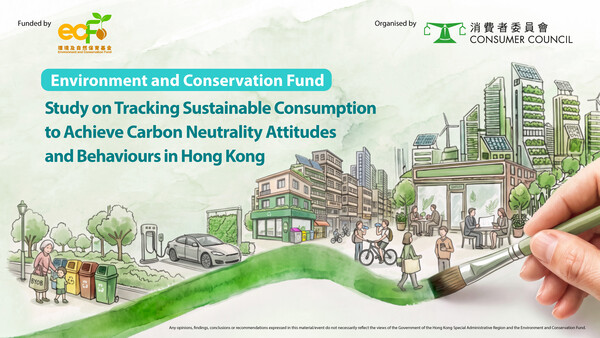
Funded by the Environment and Conservation Fund (ECF), the Council has conducted its third issue of the SC report a decade after the initial study. Titled “Environment and Conservation Fund Study on Tracking Sustainable Consumption to Achieve Carbon Neutrality Attitudes and Behaviours in Hong Kong” (“Study”), the current Study examines changes in consumers’ awareness, attitudes, behaviours and readiness since the 2015 baseline survey, identifies key drivers and hurdles for different consumer segments in pursuing SC behaviours, so as to formulate recommendations to stakeholders to jointly promote SC at various levels in society.
Sustainable Consumption Index Records Further Improvement
Progress Observed Across Most Sustainable Consumption Behaviours
The Study adopted a mixed-method approach, comprising a consumer survey through street interviews with 1,007 respondents; 6 focus group discussions involving 30 participants; trader survey with 7 sizeable supermarket and personal care chains and local e-commerce platforms; desktop research of global SC trends, as well as SC policies and initiatives in Hong Kong and other jurisdictions; and post-study stakeholder engagement sessions with the Government, public bodies, utility companies, trade associations, sizeable business groups, green groups, and academia.
The Sustainable Consumption Index (SCI) is an integrated framework developed in the 2015 baseline study to track local development and trends in SC, with a total score of 100 in each index. The 2 major indexes both showed upward trends against previous surveys: “Awareness and Attitude” increased from 74 in 2015 and 77 in 2020 to 79 in the current Study, while “Behaviour and Readiness” rose from 67 in 2015 and 71 in 2020 to 72 in the current Study, indicating continued progress in consumers’ awareness and engagement in SC over the past decade.
The 2 major indexes comprise 8 sub-indexes, most of which have improved over time, with “Energy Conservation” gaining the highest score at 84 in the current Study, nearly 10 points higher than in 2015. This was followed by “Purchasing Behaviour” (79), “Support” (79), “Waste Separation” (78) and “Conservation Behaviour” (78). While the Council observed that recycling habits for plastic and metal have gained traction over the past decade, the “Recycling Behaviour” sub-index remained unchanged at 63 across all three waves of the Study. This is possibly due to the lower recorded recycling frequency of newly included items, such as food waste recycling in the current Study, following the expansion of recycling initiatives for which users are still building familiarity and operational practices. Adding to this is the offset of the gains in plastic and metal recycling by declines in glass and paper recycling, leaving the overall score broadly unchanged.
High Action Consumers Generally with Higher Education, Income and Senior Positions
Motivation and Educational Efforts Required for Low Action Groups
The Study also found that close to one-third of consumers can be classified as “High Action Consumers”. They are predominantly consumers aged 35-54 with higher education, senior position, and higher income levels, combined with a stronger understanding of and commitment to sustainable consumption. These white-collar working consumers, commonly known as Professionals, Managers, Executives and Businesspeople (PMEBs), often work long hours and rely on takeaway meals for convenience. This consumption pattern leads to significant generation of food waste and disposable packaging during the workday. Recycling and waste collection services in commercial areas should therefore be enhanced to facilitate waste recovery from this group. As role models, this group can also help influence the low action consumers, including youth, seniors and consumers with lower education or income levels, to adopt more sustainable lifestyles.
Among the low action groups, youth (aged 15-24) and students showed significant action and relevancy gaps despite reasonable awareness and attitude, largely because waste management responsibilities are often undertaken by other household members, such as domestic helpers or older family members, limiting their motivation to participate in recycling activities. On the other end of the spectrum, the oldest demographic (aged 55-69) and no/low income/unemployed groups also scored low in the “Recycling Behaviour” and “Motivation” sub-indexes, suggesting reluctance to pay more or exert extra effort for sustainability. Targeted education and engagement efforts, as recommended in this Study, will also be important in helping these consumers translate awareness into action.
Convenience and Confidence Gap Hinder SC Behaviour Despite Motivation
High-reward, Low-effort Policies Are Key Enablers of Green Practices
Consumers showed strong concern about sustainability-related product attributes. Product lifespan ranked highest, with 87% expressing concern, although this attribute was the lowest among the youngest age group. This was followed by environmental pollution during product use (85%), animal welfare considerations (83%) and pollution arising from manufacturing processes (80%), for which significantly more educated respondents expressed concerns. In contrast, considerably fewer consumers were concerned about excessive packaging (35%) and frequent product updates (47%), suggesting that convenience, enjoyment, or aspirational value may outweigh sustainability concerns in certain purchasing situations.
Respondents also demonstrated increasingly positive attitudes towards conservation practices. The majority agreed that energy conservation (91%) and waste separation (90%) benefit the environment, while 88% considered energy conservation economically beneficial. However, the findings revealed a persisting gap between consumers’ SC awareness and action, particularly in areas requiring greater effort, behavioural changes or lifestyle compromise.
Recycling remains one of the weakest aspects of SC despite substantial expansion of recycling infrastructure and Government initiatives in recent years. Only 46% of respondents expressed confidence in the effectiveness of Hong Kong's recycling system. Focus group participants cited uncertainty regarding the destination and treatment of collected recyclables, highlighting the need for greater transparency to rebuild public trust and close the confidence gap.
The Study also found that convenience remains a major determinant of recycling behaviour, exemplified by lower adoption of actions that reduce convenience, comfort or require higher effort. Easy access to recycling facilities and supportive estate infrastructure were key enablers, while commonly cited barriers ranged from personal obstacles, such as effort and convenience, to practical challenges like space constraints and sanitary concerns. In parallel, the growing reliance on food delivery services during and after the pandemic has exacerbated the plastic waste problem, prompting the Government to introduce measures such as the “Bring Your Own Containers (BYOC) Eateries” Scheme (2023) and the “Ban on Single-Use Plastic Items” (2024) to help reduce plastic waste. Against this backdrop, the findings revealed that only 56% of respondents always or usually bring their own containers, with even less youngsters doing so, suggesting an opportunity to build a “bring-your-own-container” (BYOC) culture.
Conversely, consumers were more inclined to adopt low-effort and high-reward behaviours with immediate economic or convenience benefits, such as energy-saving measures that reduce utility costs, as well as easy social norms such as avoiding food waste. The findings suggest that policies and initiatives offering clear benefits while requiring minimal behavioural change are more likely to encourage wider adoption of SC practices.
Strong Willingness to Support Sustainable Products but Availability and Costs Remain Barriers
Knowledge Gap in Eco-labelling Undermines SC Recognition and Confidence
An overwhelming 94% of respondents expressed willingness to pay a premium for sustainable products and services, especially when it offers a direct reward. However, only 24% considered the availability of sustainable products in the marketplace to be sufficient, suggesting a gap between consumer demand and market supply. At the same time, as packaging waste remains a key waste management concern, 54% of respondents agreed to give priority to simple, environmental-friendly packaging or packaging-free products, making room to expand the availability of eco-packaging and refill-pack options. Among respondents who purchased sustainable products less frequently, high prices (58%) and insufficient information (47%) were cited as the principal obstacles.
The trader survey revealed that while some businesses have established procurement policies and monitoring systems for sustainable products, only 3 of the 7 surveyed traders priced sustainable products at the same level as comparable conventional products, underscoring the need for greater business commitment to promoting affordable and accessible sustainable choices.
The consumer survey further suggested that clear standards and recognised labelling schemes can make SC products easier to identify, effectively raise public awareness and influence behaviour, as seen in the widespread recognition of the Mandatory Energy Efficiency Labelling Scheme (MEELS) and water-saving initiatives. However, the Study revealed that there is still a profound gap between perceived and actual knowledge of eco-labelling, undermining the effectiveness of all voluntary environmental certifications.
Post-Pandemic Consumption Behaviour Presents New Sustainability Challenges
The Study found that the COVID-19 pandemic has led to lasting changes in consumption habits. Many consumers have become more reliant on food delivery services, online shopping, bulk purchasing and home delivery. Hong Kong's online retail sales expanded by 74% between 2020 and 2025, while the proportion of residents engaging in online shopping more than doubled compared with a decade ago. Increased attention to personal hygiene has also resulted in more frequent use of disposable products and sanitisation items. Convenience has taken precedence over guilt about visible waste and sustainability, spurring the growth of packaging waste and increased reliance on single-use materials. These behavioural shifts have posed significant social and economic impact on SC.
Stronger Commitment from Government and Businesses Can Drive Further Behavioural Change
Tripartite Effort to Achieve Carbon Neutrality and a Sustainable Future
The Study found that consumers viewed their own sustainability actions as conditional upon external support. 81% of respondents indicated they would do more if provided with additional information on how to practise SC, while close to 80% stated they would be motivated to take further action if the Government or businesses demonstrated stronger commitment to sustainability, rising from around 60% in 2015 and around 70% in 2020. Furthermore, consumers were more aware of, and more motivated by, initiatives that are mandatory or closely linked to personal benefits, such as the MEELS and the Plastic Shopping Bag Charging Scheme.
The findings suggest that Hong Kong’s challenge lies in bridging the gap between awareness and action, by making sustainable consumption more relevant, accessible and actionable in consumers' daily lives. The Council believes that stronger tripartite collaboration between the Government, businesses and consumers is essential in translating understanding into action and supporting Hong Kong's carbon neutrality ambitions. In view of this, the Council puts forward the following 10 recommendations for all stakeholders’ consideration.
- Carbon Neutrality and Energy Conservation
1. Accelerate Energy-efficient Equipment Retrofit in Commercial Sector
Since carbon neutrality and energy efficiency are global priorities, support for the commercial sector, the largest energy-consuming sector, should be strengthened. Local power companies are encouraged to further expand the reach and effectiveness of the existing retrofit subsidy programme through strengthening outreach to the commercial sector. Businesses are also encouraged to proactively leverage financial support to upgrade inefficient equipment, and prioritise high-impact retrofits, particularly air-conditioning systems.
2.Implement a Reward Scheme for Water Conservation at Households
To promote prudent domestic water consumption, the Council recommends that the Water Supplies Department to build on the success of its Water-Smart Taskforce Programme by providing practical water-saving advice to high-consumption households, organising competitions, and rewarding households that achieve significant water savings with GREEN$ points.
- Product Design and Information
3. Encourage Eco-packaging and Refill Packs
Businesses can consider introducing eco-packaging to ensure accessibility and inclusivity of sustainable choices across different socioeconomic groups. This could cover primary packaging, such as adopting material‑efficient and lightweight packaging designs to lower material input and transportation costs, as well as reviewing packaging strategies to avoid the use of unnecessary/hard-to-recycle packaging materials. For secondary/tertiary packaging, logistical arrangements can be improved by streamlining packaging practices across storage and distribution processes. Refill-pack offerings can also be made more widely available and commercially viable.
4. Communicate with Consumers on Product Sustainability Elements
As clear standards and officially recognised labelling schemes can effectively raise public awareness and influence behaviour, the Council suggests the Government to consider recognising and promoting credible third-party eco-labels through public education, procurement policies, and collaboration with retailers. Retailers, particularly large retail groups, are also encouraged to prioritise, monitor and expand sustainable consumption (SC) products, and leveraging brand communication and marketing to support wider adoption of sustainable products and sustainable lifestyles.
5. Enhance Product Longevity and Repairability
From the Study, consumers have expressed that extending the lifespan of products is a critical component in SC. Businesses could consider extending product functions by embedding multi-functional features to combat low-tier impulse buying; enhance product durability; offer longer warranty periods with lower renewal costs to improve consumer confidence; and ensure repairability of products by making sufficient spare parts readily available for a reasonable period of time.
- Waste Management
6. Build a “Bring Your Own Containers” (BYOC) Culture
Tripartite effort from the Government, businesses and consumers is crucial for fostering a BYOC culture to reduce waste at source. The Government could step up promotion of the BYOC Eateries Scheme and incentivise wider participation among eateries. Businesses are encouraged to provide incentives to customers for BYOC practices, such as discounts or reward points. At the same time, consumers should actively support BYOC practices to contribute to a plastic-free culture.
7. Promote Workplace Waste Separation and Recycling
Findings from the Consumer Survey indicated that white‑collar consumers demonstrate the highest levels of attitude and readiness under the SCI. To encourage waste separation and recycling at workplaces, the Government could consider launching a charter scheme to encourage developers and landlords to provide smart recycling stations, food waste and packaging collection points in high-traffic commercial and industrial areas to facilitate the recycling practices. In tandem, property management companies, owners of major commercial buildings and employers are recommended to enhance workplace recycling facilities for common office recyclables.
8. Reduce Packaging Waste from E-Commerce
To tackle the surge in online shopping packaging waste, the Government could closely communicate with cross-boundary e-commerce platforms covering sustainable packaging practices upstream, optimising logistical packaging, as well as lean logistics by downstream third-party logistics service providers. Notably, the new Mainland mandatory national standard “Requirements of Restricting Excessive Packaging in Express Delivery”, which took effect on 1 July 2026, provides a timely framework for reducing packaging waste. The standard imposes mandatory limits on excessive packaging in express delivery parcels, including cross-border e-commerce shipments to Hong Kong, thereby reducing unnecessary packaging materials at the source.
The Council also recommends the local e-commerce sector to adopt direct waste-reduction-at-source measures and achieve sustainable packaging management in their daily operations. Major logistics companies could actively participate in the Environmental Protection Department’s “Self-pickup Store On-site Recycling Project” to set up more recycling points and facilitate recycling.
9. Enhance Transparency of Recycling Process
To enhance consumer confidence in the recycling system, the Government could consider enhancing public visibility of disclosed recycling operational data such as for those concerning GREEN@COMMUNITY, kerbside recycling bins and food‑waste recycling, via social‑media channels and annual waste‑statistics reports, etc. Private property managers could improve the management of private recycling bins through clear labelling and open reporting to enhance transparency and accountability.
- Education and Promotion
10. Advance Sustainable Consumption Through Consumer Education, Business Best Practice Sharing and Innovation Adoption
For Consumers:
The recommendation in consumer education calls for the joint effort by the Government, the Consumer Council and businesses to turn abstract concepts into relevant outcomes, including translating technical terms into simple and actionable terms in public communications, and incorporating additional language to engage domestic helpers who often are responsible for handling waste at home. The 3 parties should also emphasise practical and personal advantages to encourage SC, such as money-saving benefits, health and safety, and convenience and durability. Meanwhile, social media and influencer networks could be harnessed to drive SC to target audience groups such as youth, while knowledge and adoption of SC practices could be disseminated to seniors through community centres and care teams.
For Trade:
On the business front, the Government and industry / business associations are encouraged to strengthen best practices sharing of sustainable consumption innovations and boost awareness of existing funding and support programmes through consolidated information sharing, cross-sector engagement, showcasing of proven solutions and targeted SME outreach.
The Consumer Council stresses that achieving carbon neutrality and a sustainable future cannot be accomplished by any single stakeholder acting alone. Consumers, businesses and the Government must work together to close the gap between awareness and action, creating an environment where sustainable choices become accessible, affordable and convenient.
The Council will continue to promote sustainable consumption research, consumer education and stakeholder engagement, and calls on all sectors of the community to join hands in advancing a sustainable economy and lifestyle for Hong Kong’s future generations.
Scan the QR code below, or visit https://www.consumer.org.hk/en/advocacy/study-report/ecf-sustainable-consumption-study to view the full electronic version of the “Environment and Conservation Fund Study on Tracking Sustainable Consumption to Achieve Carbon Neutrality Attitudes and Behaviours in Hong Kong” report.
