


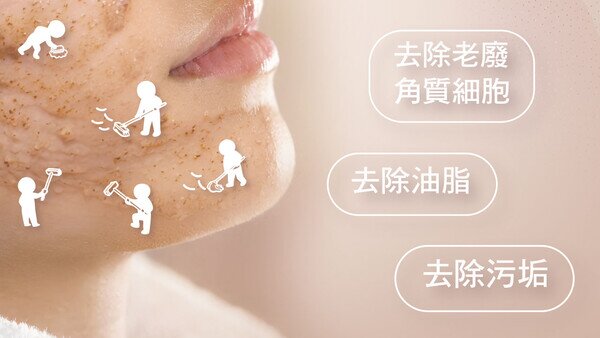
To address issues such as comedones, acne and rough, dull skin, consumers may opt for face wash products with exfoliating properties. The Consumer Council tested 25 models to assess their chemical safety and found that the content of the common exfoliating ingredients, alpha-hydroxy acids (AHAs) and salicylic acid, all complied with relevant Mainland standards. However, the pH values of 3 models were found to be lower than relevant Mainland standards, which may cause skin irritation. 6 models were labelled or described as containing AHAs or salicylic acid, but these ingredients were either not detected or only some of them were detected in the test. Suppliers responded that this might be due to the added ingredient in some samples being lower than the detection limit of the testing method as stipulated in Mainland standards.
3 models were found to contain the harmful contaminant 1,4-dioxane. Although the detected levels complied with Mainland standards, 1 model exceeded the recommended safety level set by the European Union’s (EU) Scientific Committee on Consumer Safety (SCCS). In addition, 5 models were detected with fragrance allergens at levels above 0.01% but did not declare them on the label, which was non-compliant with the EU Cosmetics Regulation. The Council urges manufacturers to stay abreast of the latest international regulations and recommendations, proactively improve product formulations and provide clear ingredient information to better safeguard consumer health.
The test covered 25 exfoliating face wash models. Apart from 1 model not labelled with any exfoliating ingredients or ingredients with “exfoliating” properties, 19 models were labelled as containing chemical exfoliating ingredients such as AHAs or salicylic acid, among which 9 also contained abrasive particles. Prices ranged from $29 to $450 per item, equivalent to unit prices of $0.2 to $5.9 per ml/g, a difference of over 28 times.
As there is no relevant legislation or standard in Hong Kong governing the chemical safety of exfoliating face wash products, the test referred to the EU Cosmetics Regulation and the Mainland’s Safety and Technical Standards for Cosmetics (2015 edition) to assess the chemical safety, including AHAs, salicylic acid, fragrance allergens, 1,4-dioxane, free formaldehyde and pH value, as well as reviewing labelling information. Physical properties or exfoliating efficacy was not included in the scope of this test.
Detected Levels of AHAs and Salicylic Acid Complied with Mainland Standards
6 Models Not Detected with or Only Detected Some of the Labelled Ingredients
AHAs and salicylic acid, a type of beta-hydroxy acids (BHAs), are common ingredients in exfoliating products and must reach a certain effective concentration to deliver results. Studies indicate that AHAs can reduce cohesion between corneocytes, aiding the shedding of surface skin, but high concentrations may cause mild discomfort such as temporary erythema, stinging and burning sensations. The Mainland’s Safety and Technical Standards for Cosmetics (2015 edition) stipulate that the total amount of AHAs in cosmetic products must not exceed 6%. 16 models were detected with AHAs, with total amounts ranging from 0.0490% to 3.4015%, all within the limit. Salicylic acid is widely used to soften keratin, control sebum and prevent acne, but excessive concentrations could be harmful. Prolonged overuse on large areas of skin may lead to salicylism, causing nausea, vomiting, dizziness and rapid breathing. 14 models were detected with salicylic acid, ranging from 0.0011% to 0.4967%, compliant with the Mainland’s 2% upper limit, with 8 models also found with AHAs.
Furthermore, 6 models claimed to contain AHAs and/or BHAs on the label, but the test did not find these claimed ingredients or only detected some of them. Responding to the Council’s enquiry, the suppliers explained that the AHAs or salicylic acid content in certain models were below the detection limit of the testing method as stipulated in Mainland standards.
3 Models with pH Values Below Mainland Standard May Cause Allergic Reactions
The pH value of products containing AHAs and BHAs is one of the key factors in determining exfoliating efficacy. However, pH is also linked to skin irritation. 1 model detected with AHAs had a pH of 2.6, non-compliant with the requirement that products containing AHAs must have a pH of not lower than 3.5 set out in the Mainland’s Safety and Technical Standards for Cosmetics. As for 2 other models claiming to contain AHAs but not detected with such, they had pH values of 2.6 and 2.7 respectively, both lower than the above-mentioned standard. Using products with excessively low pH may cause irritation and allergic reactions, leading to skin inflammation. Consumers experiencing discomfort should discontinue use of the product and consult a doctor.
About 70% of Models Detected with Fragrance Allergens
5 Models Failed to Comply with EU Labelling Requirements
None of the models were found with the 2 fragrance substances prohibited for use under the EU Cosmetics Regulation, but about 70% (18 models) were detected with 1 to 11 restricted fragrance substances, with limonene being the most common (found in 12 models) fragrance allergen. 1 model contained 11 fragrance allergens totalling 0.6305%, the highest in both types and total amount, but its label had comprehensively listed all substances to keep consumers informed.
Under the EU Cosmetics Regulation, fragrance allergens exceeding 0.01% in concentration must be declared in the ingredient list. 10 models were detected with 1 to 4 fragrance allergens above this 0.01% threshold, but 5 of them did not provide such labelling, which was non-compliant with the EU requirement. Although Hong Kong legislation currently does not mandate detailed ingredient labelling or listing fragrance allergens for cosmetic products, the Council recommends manufacturers pay attention to the latest international regulations and recommendations, and proactively improve formulations and ingredient information transparency of products to safeguard consumer health.
3 Models Detected with 1,4-Dioxane
1 Model Exceeded EU’s Recommended Level
1,4-dioxane is classified as possibly carcinogenic to humans and may form in the production process through chemical reactions. Both the EU Cosmetics Regulation and the Mainland’s Safety and Technical Standards for Cosmetics prohibit intentional addition of 1,4-dioxane, but trace amounts are allowed if technically unavoidable. The Mainland limit is 30ppm, while an EU SCCS report in 2015 recommended 10ppm or below as safe.
The test found 1,4-dioxane in 3 models, ranging from 1.44ppm to 14.60ppm, all within the Mainland’s limit, but 1 model exceeded the EU SCCS’s recommended level. Generally, face wash products have short contact time with the skin and are rinsed off immediately after cleansing, so absorption through the skin is minimal. Nevertheless, the Council encourages relevant manufacturers to improve production processes and raw materials to achieve 1,4-dioxane-free products as far as possible.
Unsatisfactory Labelling Information
Manufacturers Urged to Enhance Transparency
In terms of the product labelling, 8 models lacked detailed ingredient information in Chinese or English; 1 model did not indicate any expiry date information; and 5 models were found to have no warning statements in either language on the packaging. Manufacturers should improve product labelling to ensure accuracy and transparency.
Tips for Selecting and Using Exfoliating Face Wash Products:
- Consumers, especially those with skin conditions or prone to allergies, should test products containing AHAs and salicylic acid on small local areas of their skin before use, starting with low frequency and monitoring for reactions. Discontinue use and seek medical advice if persistent redness or discomfort occurs;
- Products with excessively low pH may cause irritation and allergic reactions upon contact, while overly high pH may damage the skin barrier and increase sensitivity risks;
- Read product instructions carefully before first use, noting recommended frequency and duration. Among the models, 40% advised daily use, about 30% recommended using 1 to 3 times per week. The leave-on time generally ranged from 20 seconds to 2 minutes;
- Reduce usage frequency during dry weather in the winter;
- Avoid contact with the eyes, mouth, nasal mucosa and inflamed acne lesions or wounds;
- After exfoliation, the skin may become dry and more vulnerable to UV rays. Apply moisturiser promptly and use sunscreen that protects against both UVA and UVB rays when outdoors, avoiding prolonged sun exposure.
Download the article (Chinese only): https://ccchoice.org/590-facewash
Consumer Council reserves all its right (including copyright) in respect of CHOICE magazine and Online CHOICE.